



What Does Place-Based Regeneration Actually Mean?
Bioregional Regeneration · Thought Leadership
What Does Place-Based Regeneration Actually Mean?
On the difference between regenerating in a place and regenerating from one.
The phrase “place-based” is rising fast in regenerative work. Five years ago it appeared occasionally. Now it shows up in funding applications, consultancy websites, farming conference programmes, and the prospectuses of new bioregional projects. It has not yet been hollowed out the way “regenerative,” “sustainable,” and “natural” were before it. But the early signs are there. The more the phrase appears, the more it is being used to mean almost anything.
A weekend workshop held on a farm becomes “place-based learning.” A grazing methodology imported from Australia and lightly adjusted for British rainfall becomes “place-based grazing.” A standard regenerative agriculture programme with a Scottish project name becomes “place-based regeneration.” Call this place-washing — the application of a label that promises rooted specificity to work that has neither. If it were just marketing, it wouldn’t matter. But the version of “place-based” we settle on now will shape what gets funded, what gets practised, and what gets lost. The window for keeping the term meaningful is open. It will not be open long.
There are two profoundly different things being called place-based regeneration. The conflation is what has hollowed the term out.
The first treats place as a container. We have a regenerative method — holistic grazing, mob stocking, agroforestry, pasture cropping, whatever the practitioner has trained in — and we apply it here. The place is where the work happens. The methodology is what the work is. Adjustments are made for local conditions. Soil type, rainfall, breed selection, market access. But the framework itself does not change much from continent to continent. The farm in Australia and the farm in Cumbria run versions of the same playbook with different weather attached.
The second treats place as the source. The place teaches us what regeneration means here. Different elemental conditions, different histories, different cultural inheritances, different soil biology, different surviving ecological intelligence — these do not just shape the application of a method, they generate it. What works in this catchment, with these soils, this rainfall pattern, this farming culture, this length of growing season, is unrepeatable. The methodology emerges from the reading of the place, not the other way around.
Most of what gets called place-based in regenerative agriculture is the first. The second is rarer, harder, and where the actual work is.
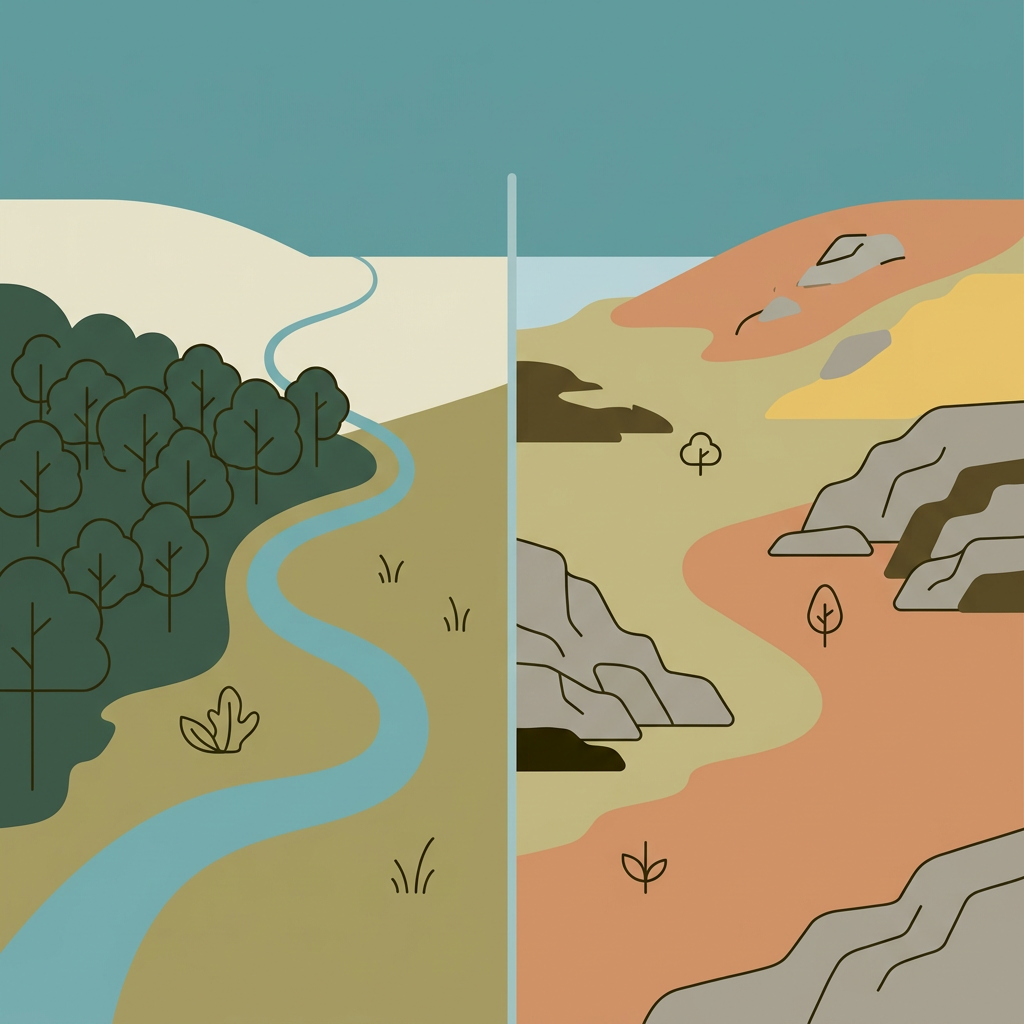
Container work has done real good. That needs saying clearly before anything else.
What corporate supply chains are doing under the regenerative label — cover cropping at scale, reduced tillage at scale, integrated livestock at scale — is genuinely better than the industrial extraction that preceded it. A field of cover crops on a Cargill contract is better than a field of bare winter soil. A million acres under reduced tillage is better than a million acres deep-ploughed every year. Ethan Soloviev and Gregory Landua’s Levels of Regenerative Agriculture framework calls this Level 1: the adoption of practices without yet shifting the underlying systems, worldviews, or paradigms. Level 1 is real progress on the industrial baseline. It is moving the floor up across millions of acres, fast, and that matters.
What needs naming alongside that, though, is what the corporate billions are doing to the conversation. When Nestlé pledges $1.3 billion, when Cargill targets ten million acres, when McDonald’s commits $200 million to regenerative beef, this capital does not just fund Level 1 work. It defines the field. It sets the language funders use, the metrics auditors require, the criteria policy frameworks adopt, the version of “regenerative” that ends up in the news. It creates a centre of gravity that pulls the whole movement toward what is controllable, certifiable, scalable, and fits inside existing supply chain logic. Which means it pulls away from what Soloviev and Landua call Levels 3 and 4 — the worldview shifts and paradigm evolution that genuine systems regeneration requires — because those things cannot be controlled, certified, or scaled in the same way.
This is not corporate malice. It is systems dynamics. Capital naturally flows to leverage points that do not threaten the structures providing the capital. But the result is a regenerative agriculture conversation increasingly defined by what is fundable rather than by what is regenerative. Place-based work, properly understood, sits at the levels the capital cannot reach. That is precisely why naming the distinction matters. Not to dismiss what the billions are achieving at Level 1, but to keep the deeper conversation alive while it is happening.
The capital does not just shape what gets funded. It shapes what gets asked. When billions flow into “regenerative” supply chains, the corporations writing the cheques also write the rules of what counts as regenerative method. Glyphosate is the obvious example. The continued, unquestioned use of glyphosate inside corporate regenerative programmes is not a regenerative practice. It is a symptom of annual commodity cropping, which is the system the capital is committed to maintaining. The honest question — how do we produce healthy, nourishing food for our local regions? — gets replaced by a narrower one: how do we produce annual wheat without glyphosate inside a regenerative framework? And the answer is: you can’t. The first question opens up bioregional food systems, perennial polycultures, integrated livestock, mixed farming, the whole landscape. The second one funds another round of cover crop trials. Place-based regeneration starts with the first question.
Others have been doing the deeper work for years.
Carol Sanford has spent four decades arguing — mostly into business and organisational contexts — that regeneration is always specific to a particular Place, Person, and Process, and that the colonial error is making one answer work for everywhere. Pamela Mang and Bill Reed at Regenesis Group have built an entire methodology, the Story of Place, around surfacing the unique evolutionary role of a particular place rather than applying templates to it. Daniel Christian Wahl writes about re-inhabitation, about cultures patterned by the places they inhabit, in a body of work now several books deep. Jenny Andersson at the Really Regenerative Centre has been publishing on place-based community-led regeneration in the UK and Europe. Joe Brewer’s Design Pathway for Regenerating Earth proposes bioregioning as a verb, not a project. The deep stream is real. None of this is being invented now.
But there is a gap. All of this work has developed, mostly, inside human systems. Sanford works with companies and leadership teams. Regenesis works with developers, planners, and community design. Wahl works at the level of culture and economy. Andersson works in community-led regeneration. The place where regenerative agriculture actually happens — the catchment, the hill, the soil profile, the successional sequence of plants over a hundred years, the relationship between a farmer and their land — has not been given the same depth of place-thinking that the human-systems work has had. We have a richer vocabulary for the essence of a business than for the essence of a hillside.
That has consequences. It means the language of place-based regeneration can travel into farming and rural land management without the discipline that makes it work. It means a farmer can be told they are doing “place-based regeneration” when what they are doing is implementing a methodology that was designed somewhere else. It means funders can fund “place-based” projects across half a country and not notice that all the projects look the same.
There is also the older question. Place-based knowing is not a regenerative invention. It is indigenous epistemology, three thousand years deep across many continents, and the contemporary regenerative movement is using vocabulary it did not originate. Failing to name this leaves regenerative discourse in exactly the position it is trying to escape — taking from a tradition without acknowledging where the taking happens.
Here is where ecology helps.
Ecological succession is the most rigorous account of place-as-source we have. When a glacier retreats, when a wood is felled, when a peat bog floods, when a fire moves through a moor — what happens next is determined by the specific elemental conditions of that exact site. The substrate. The moisture. The slope. The aspect. The seed rain available from neighbouring habitats. The residue of what was there before. The pioneer species that happen to arrive first. The microclimate. The hydrology. Two adjacent valleys with the same regional climate produce different successional sequences because their soils differ, their aspects differ, their water differs.
Ecologists have a word for this: edaphic climax. The mature plant community shaped by local soil, water, and topography rather than by regional climate alone. The same disturbance event in two different places does not produce the same recovery trajectory. It cannot. The conditions are not the same.
This has been understood for a century. It is not contested ecology. It is foundational ecology. And it is precisely the model that regenerative discourse has been reaching for without quite finding.
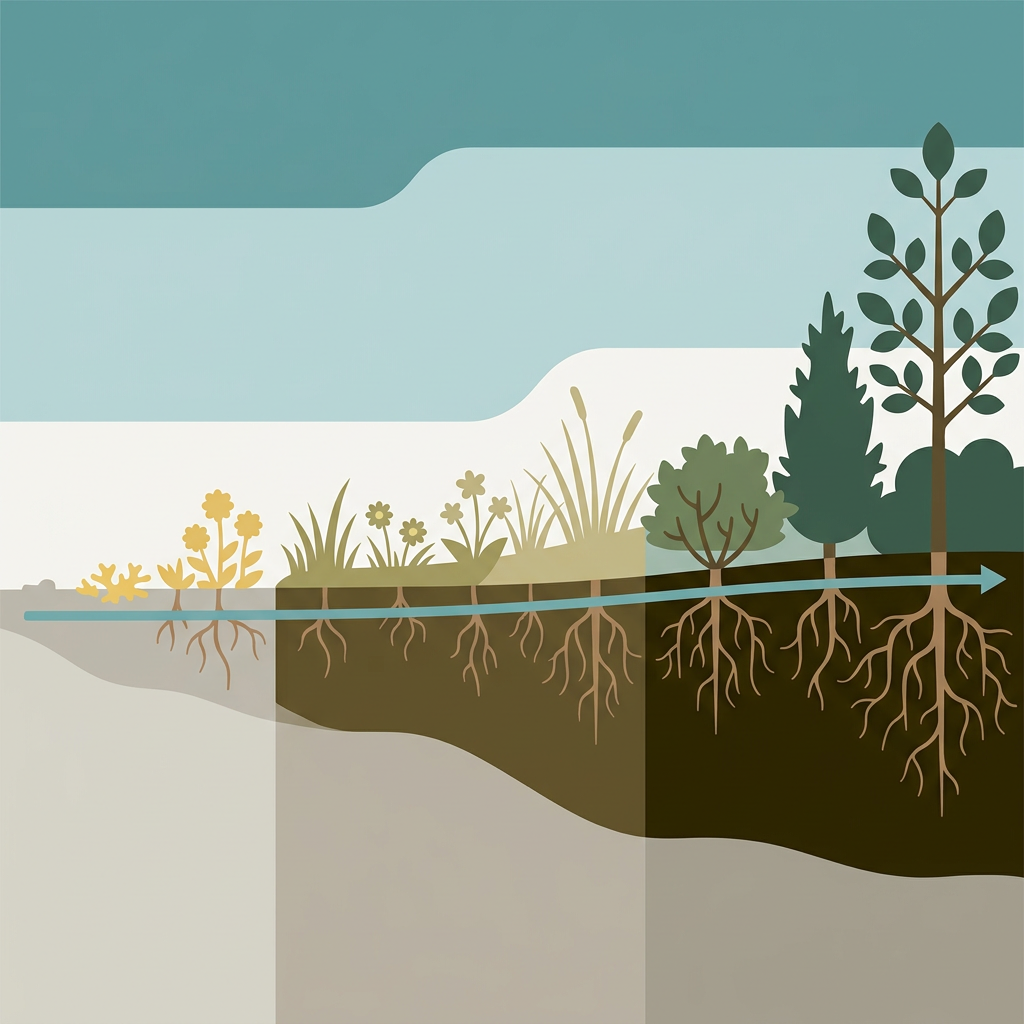
Because regeneration is a successional process. That is what regeneration is. It is not the application of a method. It is what happens when a system is allowed to move from a simpler state to a more complex one through its own internal logic, drawing on the elemental conditions that are actually there. Each successional step emerges from what the previous one created. Pioneer species change soil chemistry, which makes way for the next layer of species, which changes the moisture regime, which makes way for the layer after that. Nothing is generic. Every step is determined by what came before, and by what the local conditions allow. The system regenerates from itself, in the conditions of its own particular place.
This is the ecological grounding that “place-based” should mean. Not “designed to be sensitive to local conditions,” which is the soft version. But regenerated from local conditions — which is what succession actually does, and what genuine place-based regeneration must learn to do.
None of this is an argument against frameworks. It is an argument against confusing two different kinds of framework, which is what regenerative discourse has been doing.
There are content frameworks. Templates that tell you what the answer should look like. What practices to adopt. What outcomes to target. What the regenerative farm of the future should produce. These travel poorly. They prescribe before they listen. They produce the same outputs in different places and call the differences cosmetic. These are what should travel less than they do.
And there are process frameworks. Structured ways of paying attention. They tell you what to look at, what to ask, what to read in a landscape, what to notice in the relationships between people and place. They scaffold inquiry rather than prescribe outcomes. The Story of Place is one. Sanford’s Seven First Principles is another. The ROOTED framework — developed at Roots of Nature and used as the underpinning methodology of Wilderculture and the Roots to Regeneration training programme — is another. These are not the enemy of place-based work. They are how you do it.
The twelve regenerative principles that sit at the heart of the ROOTED framework — cycles and seasons, closed-loop zero waste, fractal patterns, dynamic communication networks, diversity and synergy, evolutionary emergence, and the rest — operate the same way. They describe patterns that show up in every functioning living system, on every continent, in every habitat. Not as analogy. As fact.
The principles are universal. The expression is unrepeatable.
Every functioning ecosystem cycles. The rhythms differ — a tropical reef cycles through tides and seasonal coral spawning, a peat bog cycles through wet and dry seasons that build and decompose vegetation across slow geological time, a chalk grassland cycles through grazing pressure and flowering succession in a single year — but the cycling itself is universal. Every functioning ecosystem produces no waste. What one organism excretes another consumes; what one season builds another releases; nothing leaves the system. Every functioning ecosystem runs communication networks — mycorrhizal in temperate woodland, chemical and acoustic in coral, electrical and root-borne in grassland. Every functioning ecosystem expresses fractal complexity, with the same patterns of self-organisation operating from soil aggregate to landscape.
These are not metaphors borrowed from ecology to make a point. They are how life actually works, everywhere it works. Which is why the principles can travel without being prescriptive. They do not tell us what this peat bog should become, or what this hill farm should look like. They give us lenses to see what is already there — what is cycling, what is closing loops, what is communicating, what is emerging — and what the place is trying to become next.
The principles are universal. The expression is unrepeatable. A peat bog above Lismore expresses cycles and zero waste and communication networks in ways no other ecosystem on earth does, because the elemental conditions of that bog — its hydrology, its peat depth, its microbial community, its history of management, its position in the catchment — are unique. The principles are how we read what is happening. The reading is always particular.
This distinction matters because the alternative — rejecting frameworks altogether in the name of place — leads either to mysticism or to making everything up from scratch every time, which is not what good practitioners do. Good practitioners use sharp tools to see clearly. The tools are the framework. What they see is determined by the place. Both halves are needed.
The way ROOTED works in practice follows from this directly. The framework operates at farm scale and at bioregional scale because it is fractal — the same pattern of inquiry applies at every scale, and what it surfaces at each is different. Read the elemental conditions. Read the context across environmental, social, and economic dimensions. Read the whole-system function. Read the nested whole. The lenses are the same. What they reveal is not.
A farm in Glen Lyon and a farm in the Yorkshire Dales will produce two different ROOTED readings, two different designs, two different sequences of practice — because what the lenses see at each is different. A bioregional programme in the Cairngorms and a bioregional programme in the Lake District Fells will move through the same ROOTED process and produce two different bioregional plans. The framework is universal in pattern. The methodology that emerges is unique in expression. This is how succession works at every scale at which succession works, from the rotting log to the continent.
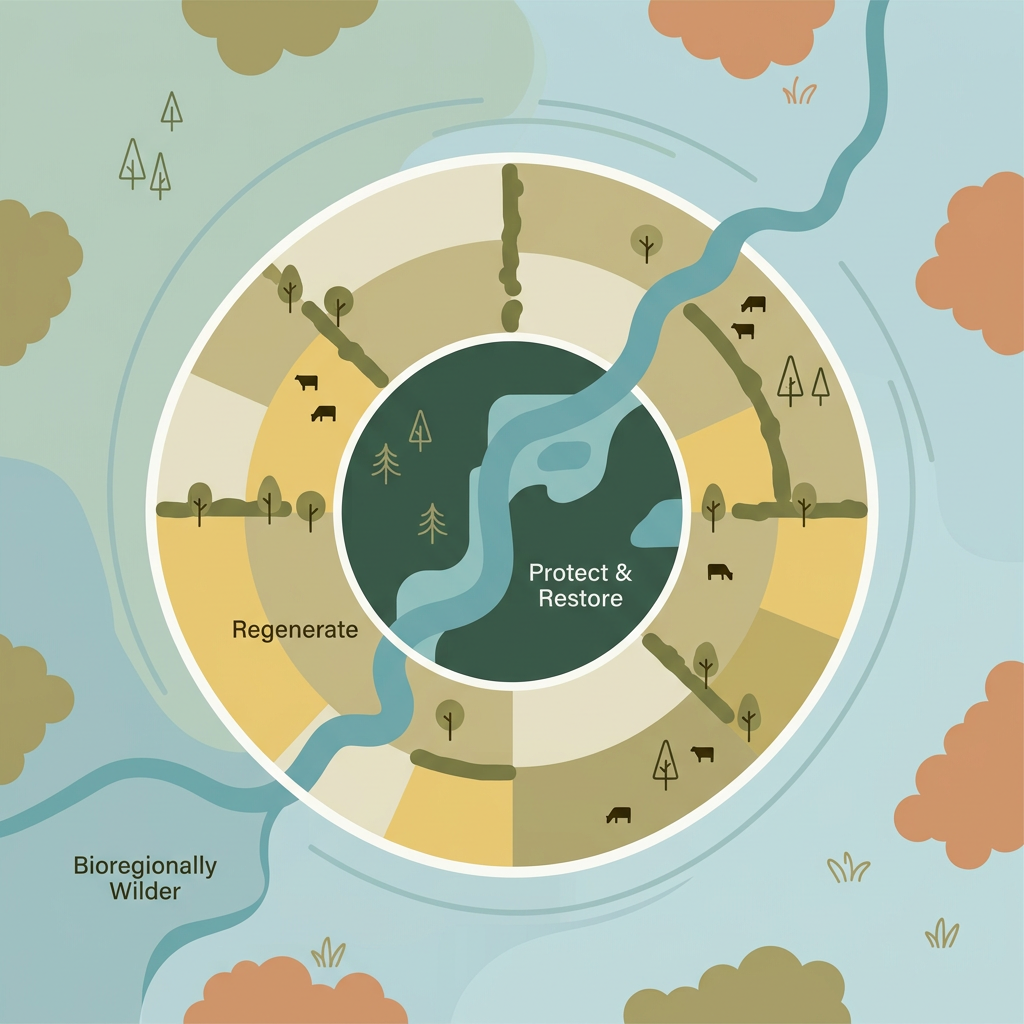
Wilderculture’s WILD Map — Protect & Restore, Regenerate, Bioregionally Wilder — follows the same logic, applied to land. It is not a delivery plan. It is a successional architecture. Hold what is fragile. Build complexity where the conditions allow. Release toward greater wildness where succession can take it. What this looks like on the ground depends on the land itself and on the people who hold it. A high-rainfall West Highland croft, a Lake District hill farm, a Pennine commons, a Welsh upland tenancy, and a Cairngorms estate will each produce a different WILD Map — different proportions, different boundaries, different sequences — because their elemental conditions differ and because the goals, traditions, and capacities of the people working them differ. We do not decide in advance what proportion of a bioregion belongs in each zone. The reading tells us. The land tells us. The people tell us. The work is to listen well enough to all three.
What this looks like in practice — how a bioregional weaver actually does this work, what successional mapping reveals about a landscape, what changes across the years of a programme — is the subject of the next piece in this series.
So: what does place-based regeneration actually mean?
It is not a label attached to a methodology. It is a discipline of attention. It refuses to know the answer before listening to the question. It begins with the elemental conditions of an actual place, applies the lenses of how living systems work to read what is there and what is emerging, and follows succession one step at a time — supporting what the place is already trying to become rather than imposing what we have decided it should be.
This is patient work. It is not generic, and it cannot be made generic. Generic methodologies will continue to call themselves place-based, because the term sells. Real place-based regeneration will continue to be slower, harder, less marketable, and more durable.
It is also why, in a regenerative movement increasingly tempted by scaled, branded, and standardised approaches, the discipline matters. A landscape regenerated from itself, in its own conditions, by people rooted in its particular history and held in the right relationship with its particular ecology, will outlast any methodology imposed on it from outside. Succession knows this. Indigenous practitioners have known it for thousands of years. Regenerative agriculture is finally being asked to take it seriously.
That is the work in front of us.
This is the first in a series of papers exploring place-based regeneration through the lens of Wilderculture’s bioregional methodology. The next piece develops the successional approach to bioregional regeneration in depth — what it means to read a landscape’s succession stage, and how the work changes across the years of a bioregional programme.
Written in dialogue with Claude (Anthropic). Ideas, arguments and experience are mine; AI helped research, structure and articulate them.
No Comments