

Wilder Economies
What a Wilder Economy Looks Like
The qualitative picture is concrete and recognisable.
Viable farming households
Economically viable through the genuine value their land and labour create — nutrient-dense food, healthy soils that hold water and sequester carbon, regenerating ecosystems — rather than dependent on subsidy structures that can be withdrawn at a policy change.
Short supply chains
Food circulating between the people who produce it and the people who eat it, without the long extractive routes through commodity markets that currently take most of the value out of farming communities.
Wealth that stays
Cooperative ownership structures, community share offers, and place-based investment vehicles return profits to the communities the work happens in, rather than to distant shareholders.
Read the full section
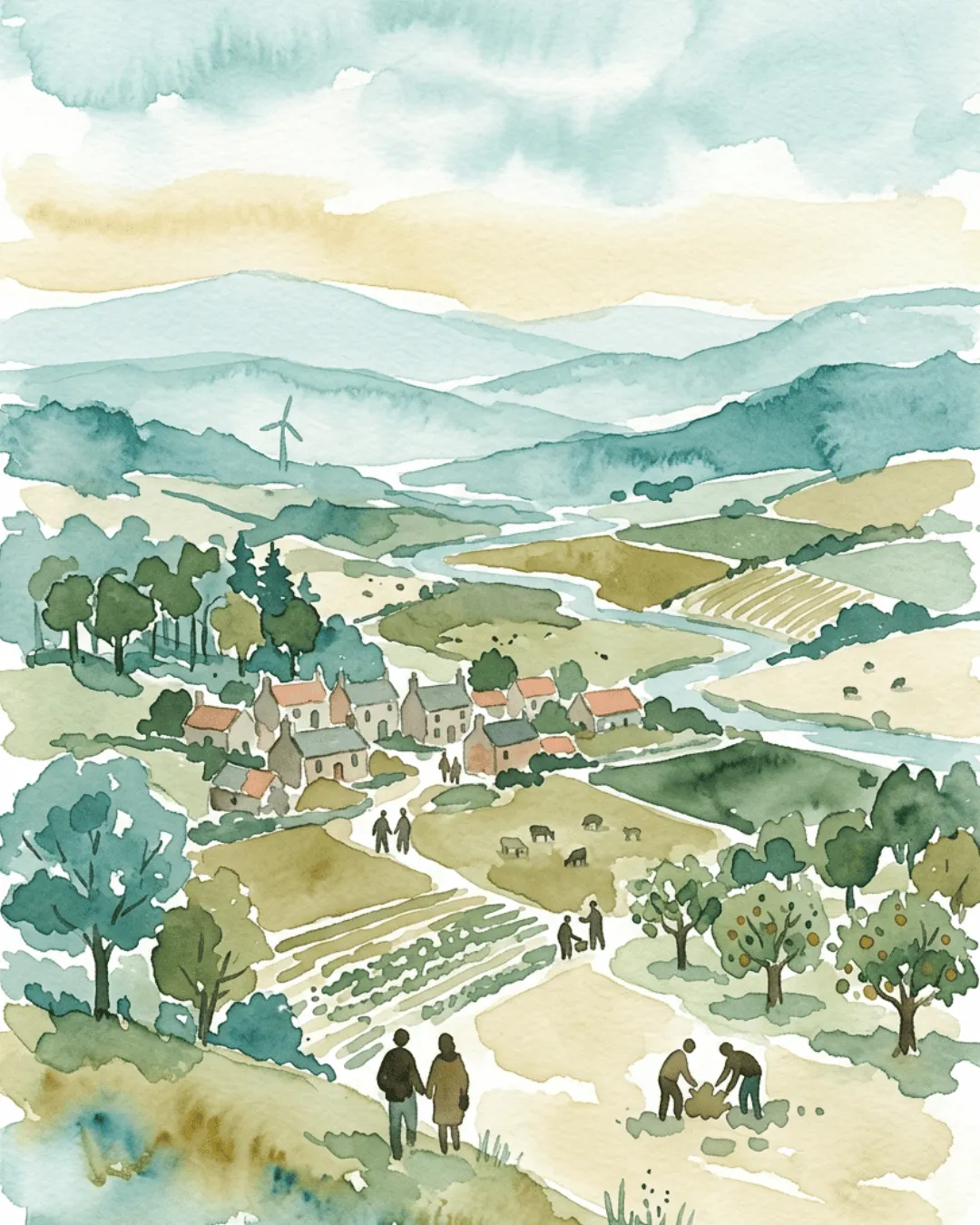
Local enterprises sit nested within their bioregion: a small abattoir close enough to its livestock farms to make the welfare and economic case both stronger; a butcher training programme that holds skill in place rather than losing it; a food hub that aggregates produce from many farms so it can reach markets none of them could reach alone; a community-supported agriculture network that distributes risk and reward across the people the food actually feeds. Orchards and market gardens — high-value productive nodes within larger regenerative holdings — plug into the wider landscape rather than sitting apart from it.
Cultural and heritage enterprises — built on the genuine intelligence of how these landscapes have been managed — contribute to livelihoods without commodifying what they draw on. The economy is diverse, locally adapted, and resilient by virtue of its diversity. It is not an economy that depends on a single commodity, a single policy, or a single supply chain.
The Economic Dimension of Bioregional Regeneration
Wilder Economies is the economic dimension of Wilderculture's work — how value circulates in a bioregion, what enterprises operate within it, and whether the wealth that the land and the people generate stays in the place that produced it or is extracted to somewhere else. The economic dimension is not separable from the ecological and cultural ones. A regenerating landscape with no economic ground under it will not regenerate for long; a community without economic purpose loses the demographic and cultural vitality that regeneration requires. The three Fields move together, or they do not move at all.
How a Wilder Economy Develops
A wilder economy develops the way a recovering ecosystem develops: through stages, each preparing the conditions for the next. Stages cannot be skipped.
Early Succession
Relationships first.
In an early-succession bioregion, the economic conditions for regenerative work do not yet exist. The work at this stage is building the relational and cultural conditions out of which they can emerge.
Mid-Succession
Infrastructure becomes investable.
The bioregion begins to develop the nodal infrastructure that a wilder economy requires: small abattoirs, food hubs, cooperative marketing structures, apprenticeship pathways, processing capacity.
Late Succession
The economy runs largely on its own complexity.
The diversified local economy is generating genuine surplus, and the community has the economic density and distributed governance to manage its own development.
Read the full section
Early Succession. In an early-succession bioregion, the economic conditions for regenerative work — local food infrastructure, cooperative enterprises, circular value flows — do not yet exist. The work at this stage is building the relational and cultural conditions out of which they can emerge: farmer networks, community gatherings, the shared understanding of place that any later collective economic action depends on. Investment here is patient, philanthropic, and oriented toward developing the substrate rather than producing measurable economic outputs.
Mid-Succession. As the relational substrate matures, the bioregion begins to develop the nodal infrastructure that a wilder economy requires: small abattoirs, food hubs, cooperative marketing structures, apprenticeship pathways, processing capacity, the first wave of locally-nested enterprises. Blended capital becomes appropriate here — philanthropic foundations alongside patient impact capital, structured to match the timescales the work actually operates on. This is where the economic vision starts to become tangible: enterprises operating, value circulating locally, the first signs of wealth retention.
Late Succession. In a late-succession bioregion, the diversified local economy is generating genuine surplus, the cooperative and ownership structures are operating well enough that the system is self-organising, and the community has the economic density and the distributed governance to manage its own development. External capital still flows in and out, but the economic centre of gravity is local. This is the condition the work is ultimately for — a place where regenerative livelihoods are no longer the exception, and the bioregion's economic life is built around what its land, water, and people genuinely sustain.
Diversity is not a luxury here. It is the structural condition resilience requires.
Bioregional Financial Infrastructure
A wilder economy needs financial infrastructure that matches its timescales and its values — capital that can wait, that can hold complexity, and that flows toward regenerative outcomes rather than extracting from them.
Read the full section
This kind of infrastructure is not yet widely available, but it is being developed. Around the world, a new generation of practitioners is designing place-based financial mechanisms — Bioregional Trusts, Venture Studios, Bioregional Banks, and other instruments — that channel patient capital into the regenerative work specific bioregions actually need.
The most developed work is happening in places like the BioFi Project, which has set out a framework for Bioregional Financing Facilities — a layered architecture of place-based financial instruments designed to connect capital with regenerative initiatives at bioregional scale — and the Place Finance Lab, which is designing financial instruments specifically for food system transformation alongside regional partners. We pay close attention to this work. As bioregional projects in the UK uplands mature toward mid-succession and beyond, the financial infrastructure these international peers are developing will be part of how the capital architecture for our own work evolves.
In the meantime, Wilderculture's own capital architecture in the early succession phase is appropriate to the work: philanthropic and grant funding from foundations and public bodies, alongside partnership relationships with National Parks, agricultural organisations, and regenerative peers. The work of building bioregional financial infrastructure here in the UK uplands begins where it has to begin — with the relational and cultural conditions that financial mechanisms ultimately depend on.
Economic Soil
The economic dimension of bioregional regeneration grows from the same substrate as the ecological and cultural dimensions: the relationships, the systems-thinking capacity, the shared understanding of place that any sustained collective work depends on. Through the ROOTED framework and the Rooting to Place process, we work alongside community members to develop the economic literacy, regenerative leadership, and place-based business thinking that an emerging wilder economy needs.
Read the full section
This foundational work identifies the people in a bioregion who could become the founders, leaders, and stewards of the next phase of economic activity — and gives them the developmental ground they need to do it well. It also surfaces the latent economic intelligence already present in the community: the trade routes that used to operate, the products this place has historically produced, the local materials and seasonal patterns that an honest economic strategy would build on. Plans developed without this substrate tend to be plans imposed on places. Plans developed with it can hold.
Why Diversified Local Economies Hold
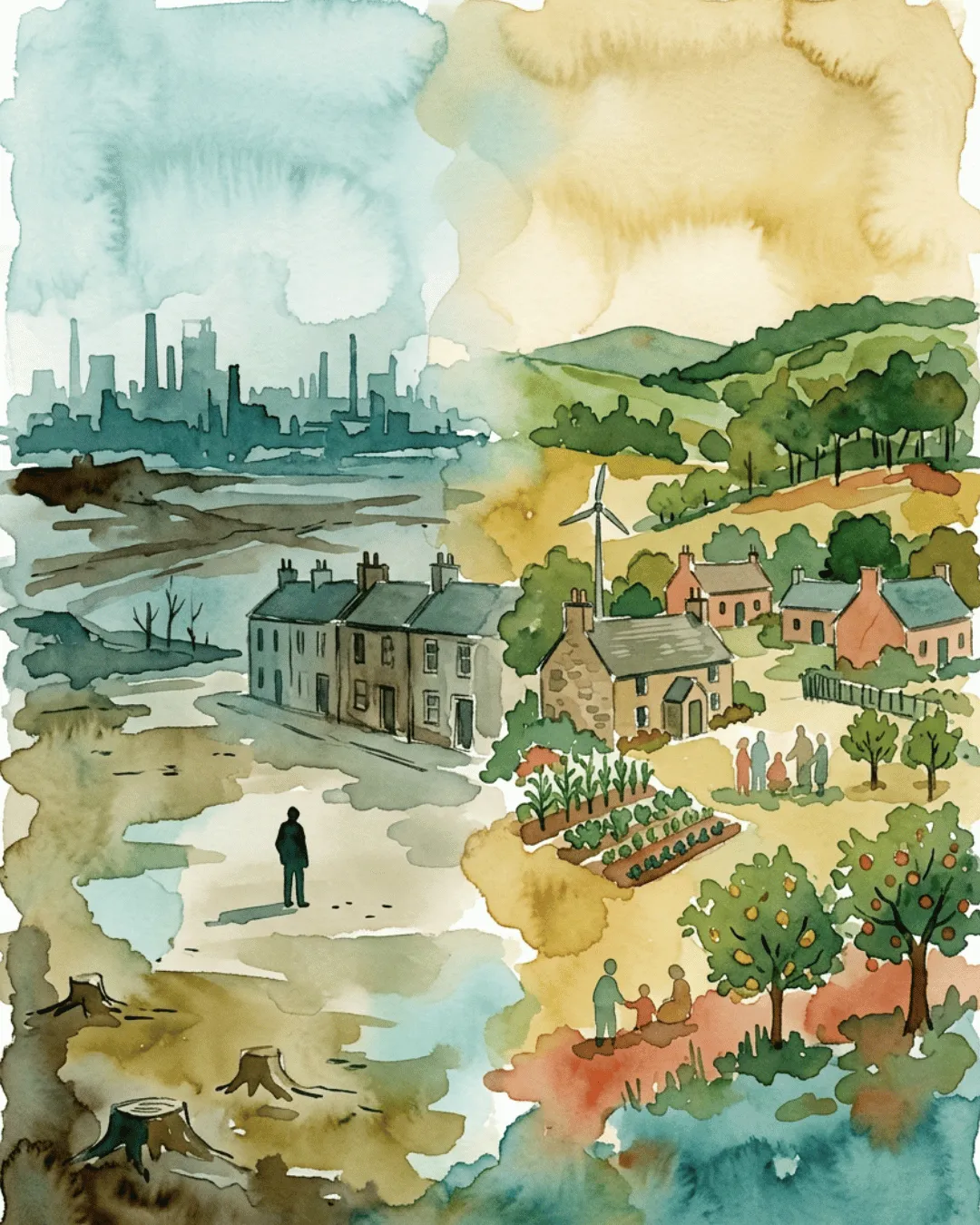
A wilder economy is resilient by virtue of its diversity. Where conventional rural economies depend on a single commodity supply chain, a single subsidy structure, or a single buyer, a bioregional economy in mid-succession or beyond holds many strands at once: regenerative farming households generating multiple revenue streams; food enterprises operating at the scale local markets can actually carry; cooperative ownership structures returning value to the people doing the work; cultural and heritage enterprises building livelihoods from genuine place-knowledge. When one strand falters, others hold. Diversity is not a luxury here. It is the structural condition resilience requires.
Where the Work Is Focused
Wilderculture's deep place-based work focuses on six UK upland regions — the Eastern Highlands, the West Highlands and Islands, the Scottish Southern Uplands, the Northern English Borderlands, the Lake District Fells, and the Yorkshire Dales and Bowland. Each region carries its own economic conditions, its own historical patterns of value flow and value extraction, and its own particular questions about what a regenerative economy here could look like. Working in depth in these places — rather than across more places more thinly — is how the bioregional economic argument becomes legible in practice rather than only in theory. What works in one region informs how the same patterns are tested in the next, but the specific economic strategy of each is local to itself.
Where the Economic Work Is Heading
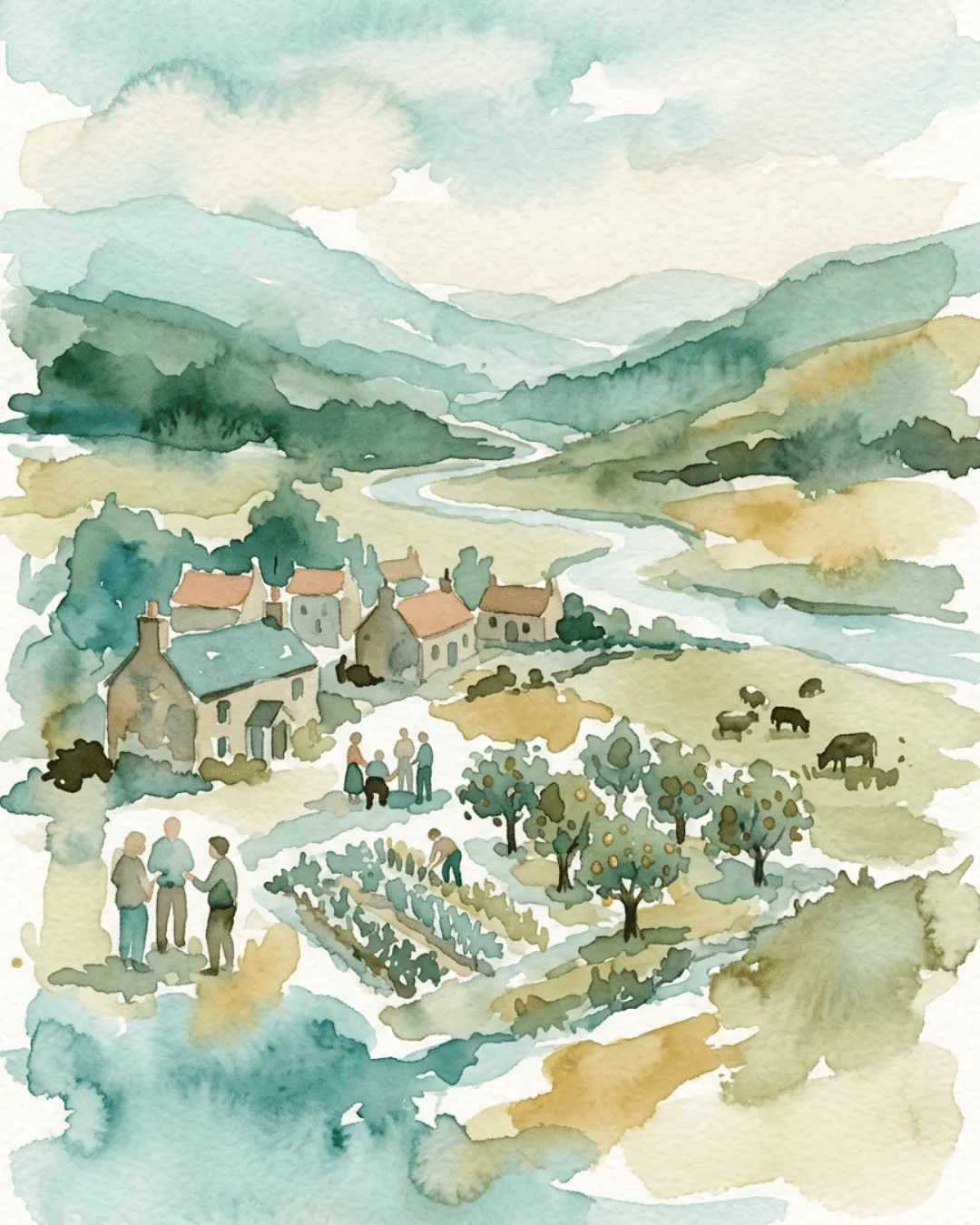
By 2035, our mature bioregional hubs will demonstrate how community-led economic development can support the regeneration of 1 million hectares whilst cultivating a global community of 10,000 regenerative practitioners. These hubs will serve as economic engines that:
- Generate sustainable livelihoods through regenerative enterprises rooted in place
- Retain wealth locally through cooperative ownership and circular economic networks
- Support landscape-scale restoration through economically viable regenerative practices
- Create replicable models for community-led economic development in upland and marginal bioregions
Read the full section
By 2046, Wilderculture's goal is measurable regeneration across one million hectares and six UK upland regions — land, livelihoods, and culture recovering together. The economic dimension of that goal is not separate from the ecological and cultural dimensions. It is what makes the work durable. A bioregion in mid-succession or beyond will be one where the economic conditions of regenerative land management are actually viable — where the farming households doing the work are economically resilient, where local food systems retain value rather than leak it, and where the financial infrastructure for ongoing investment is in place.
Alongside the deep place-based work in the UK uplands, a global community of citizens applying these patterns in their own places — anyone, anywhere, beginning where they are — is testing what wilder economies look like in conditions the UK uplands cannot replicate. Their experiments and adaptations feed back into how the methodology develops. The two scales feed each other: the deep work develops the economic strategies in the most demanding upland conditions; the wide work tests them across the diverse places where Wilderculture's methodology is being applied internationally.