


Rewild, Farm or Conserve? The Uplands Need a Better Question
Wilderculture
Essay · Land use
Rewild, Farm or Conserve? The Uplands Need a Better Question
Rewilding, farming or conservation? The UK uplands don’t need a winner — they need reading.
You can feel the argument in the hills before anyone says a word. On one side, the case for letting the land go wild: the grazing has stripped it bare, the science is in, step back and let nature come home. On the other, the farming families who have worked that ground for generations, watching a lifetime’s knowledge recast as the thing that went wrong. And between them the conservation bodies, holding their designated sites and their species lists, trying to keep what is left. Three camps, one hillside, and a conversation that has set hard into a fight about who should win.
Underneath every version of that fight is the same question: should we spare this land for nature, or farm it? Spare it or share it. Produce on it or protect it. It is the question behind the academic debate over “land sparing versus land sharing,” behind the three-compartment models in the policy reviews, behind the new Land Use Framework’s careful talk of “right use, right place.” And it is the wrong question.
It is the wrong question because nature does not stop at a fence. You cannot draw a line, rewild one side of it, farm the other side hard with chemicals, and call the whole thing balanced. The water moves. The soil moves. The birds and insects that need three different habitats to get through a single year move. A hillside is one system, breathing in and out across whatever boundaries we paint on the map, and the moment you treat it as two compartments — one for food, one for nature — you have misread the thing you are trying to manage.
There is a second reason the question misleads, and it matters more in the uplands than almost anywhere. The argument for sparing the high ground rests on a quiet assumption: that the uplands are marginal, low-value, more or less useless for production, so we may as well hand them to wild nature. But the uplands are not useless. They are degraded — and those are not the same thing.
Here it helps to look down, at the soil. A healthy upland soil is not a fixed thing; it is the running total of what lives on it. Under deep-rooted trees and a varied sward, with animals moving through and dunging and moving on, the roots reach down into the rock, draw up the minerals locked there, and drop them back as rich litter that the worms work into a dark, living, fertile ground. Take the trees off, graze the ground hard and keep it short for long enough, and that whole engine switches off. The roots no longer reach the rock. The rain, on hard stone and steep slopes, washes the goodness out faster than anything can replace it. The soil sours, the worms leave, and what remains is a thin, acid, locked-up ground that grows little but rush and mat-grass.
What we are often looking at, then, when we look at “natural” open moor on ground that could once have carried woodland, is not nature’s ceiling. It is a fallen state. The soil has not paused at some wild climax. It has gone backwards.
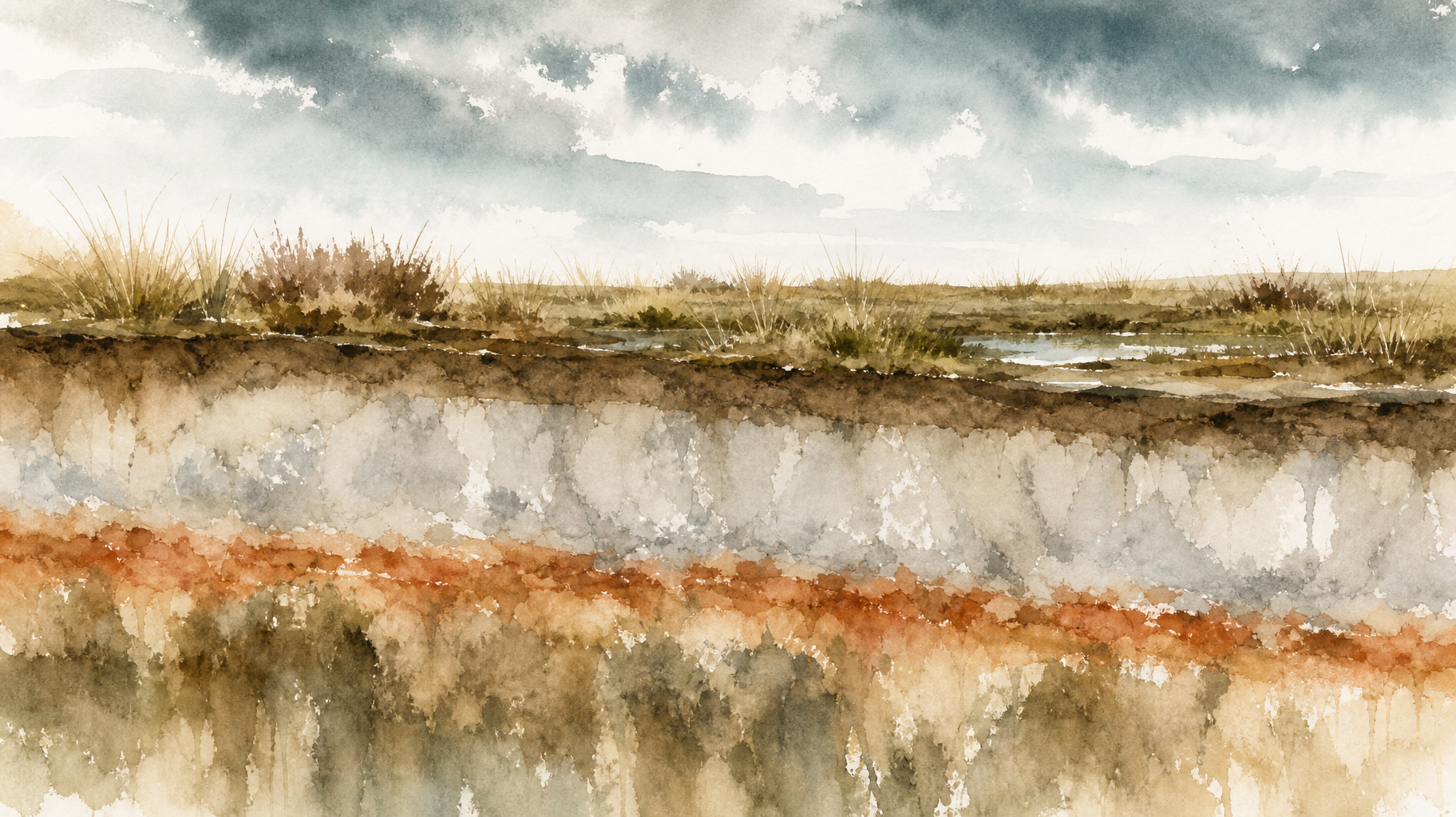
This changes what rewilding can and cannot do on its own. There is a comforting idea that if we simply rest the hills — pull the stock off, stand back, wait — nature will climb back to where it was. Sometimes, on kinder ground, it does. But a degraded upland soil does not behave like a spring that bounces back when you lift the weight off. It behaves like a system that has settled into a new, lower, stubborn equilibrium and has every reason to stay there. The sour soil suits the rush and the mat-grass that keep it sour. The missing trees cannot seed back through the grazing and the wind. Rest alone, on the most fragile, base-poor, high-rainfall ground, can leave you waiting a very long time for a recovery that never quite comes.
Which leads somewhere that tends to surprise people on both sides of the fight. If the uplands are where the land is most degraded and most locked, then they are exactly where walking away is least likely to work — and where skilled human hands matter most, not least. For most of our history these hills were held by a wilder system: woodland, grazing animals, and the predators that kept those animals moving and the trees coming. That system built the fertility we have spent a few centuries spending. The predators are gone. The wood is mostly gone. We cannot wish the old system back, and we will not get it back through absence alone. But we can take up its work consciously — moving grazing animals the way the predators once did, helping trees and seed back onto ground that can no longer reseed itself, reading a landscape closely enough to know what it is trying to become and lending a hand to get it there.
So if the question is not “spare it or farm it,” what is it?
It is tempting to answer: what does the land want to be? But that gives the land a personality it does not have. Left wholly to itself, a hillside would most likely go as wild as it possibly could; it has no interest in feeding us and no opinion about our schemes. The honest question is harder, and it is this: what is the best use of this particular place — and that cannot be answered without the people who hold it and what they want from their lives on it.
The uplands do not need a winner. They need reading — of the ground, and of the people who hold it.
Because the land is not a blank public canvas. Almost all of it is in private hands. And unless we mean to take it into state ownership, or dictate from the centre what every farmer and estate must do with their acres, we are left with the only honest alternative — and we should be glad of it. Command from above is precisely what has lurched these hills from one fashion to the next: drain it, then rewet it; plant it, then fell it; count the stock up, then pull them off. Swing follows swing, and the land pays for each. The answer is not a cleverer central plan. It is a great web of local judgements — many people, each reading their own ground, deciding what is good for it and for them.
That reading has a shape, and it is the heart of how we work — the integrated way of looking at a landscape that we call WILD. It begins with the people: what do those who live and work this place actually want from it? How much do they want to farm, and how hard? Which creatures, which views, which way of life do they care about, and what do they hope to hand on? Then it turns to the ground itself — the geology and the water, the old tracks and the buildings, the rare things already clinging on, the fields so long drained and limed and worked that farming them well is the honest path, and the real limits and openings that decide what food this place can produce. And then the hard arithmetic: given what the land can do and what the family need, what living can actually be made here — one that stands on its own sunlight and soil, rather than on subsidy and paper promises that shift with each new government?
Answer those, in that order, and the three levels begin to arrange themselves. Some ground will be protected and restored, because something rare is already there. Some will be farmed, and farmed regeneratively, because it has been modified long past the point of pretending otherwise, and because people must make a living and eat. And some will be let go toward the wild.
The wild is not forgotten in that — it is honoured properly. Reading where a place came from, the stages it has moved through, and what it would tend toward if simply left to succeed without us: that is the work we call Rooting to Place, and it is the truest answer to what the land “would be.” It tells you the trajectory the ground is already on, the wildness it is reaching for. But it is one voice at the table, not the whole conversation — the land’s own tendency, set beside the lives of the people who hold it.
Do all this on a single farm and you get one honest answer, particular to that place. Do it on every farm — each with its own people, its own rock and water, its own economics — and something emerges that no map drawn from a desk could design: a patchwork of genuinely different decisions, and with it a natural diversity stitched right through the landscape. Not imposed. Grown.
And there is one further turn. As neighbours begin to work together — a valley, a community, a whole region — those separate readings can be woven into a shared bioregional plan, so that each holding’s choices also answer to what the wider region needs, and to what is singular about its nature, its culture and its past. That is where the private and the wild and the common good finally come into line: not by command from above, but by a hundred local readings that have learned to listen to one another, and to the place.
The rewilders are right that much of the hill should be wilder, and could be gloriously so. The farmers are right that we must produce food, and that good farming is part of the answer rather than the enemy of it. The conservationists are right that some things are rare enough to need protecting now. They are all right — about different parts of the same hillside, held by different people, reaching toward different things. The mistake was ever thinking the land owed us a single answer, or that one rule from the centre could find it.
The uplands do not need a winner. They need reading — of the ground, and of the people who hold it. That is slower than an argument and harder than a slogan. It is also, we think, the thing most likely to bring these landscapes, and the communities rooted in them, back to life.
No Comments