

Working With Farmers Regenerating UK Uplands Together
Specialist Regenerative Agriculture for Upland and Marginal Landscapes
Wilderculture has spent fifteen years working with farmers and land managers across the UK uplands. Our founder Caroline Grindrod and our practitioner network have advised on the regeneration of hundreds of thousands of acres of upland country — Cumbrian fell farms, Highland sporting estates, Pennine hill farms, Border country uplands, and emerging work in the Hebrides. The Wilderculture methodology has been forged through that work: developed from the ground up in relationship with these landscapes, not adapted from other contexts. Whether you’re a farmer, crofter, estate manager, or running a conservation project using livestock, the work on this page is for you if you’re serious about regenerative transition.
Two Ways to Work With Us
Join a Bioregional Farmer Network
Our bioregional networks offer fully-funded, intensive support to farmers in our six priority upland regions: the Eastern Highlands, West Highlands & Islands, Scottish Southern Uplands, Northern English Borderlands, Lake District Fells, and Yorkshire Dales & Bowland.
Each network brings together 8–12 farmers for 18–24 months of fully-funded training, coaching and whole-farm planning — individual farm visits, peer learning, and access to collaborative funding — with ongoing network membership once the intensive phase ends.
We’re looking for farmers working upland or marginal land (from around 25 hectares) who are committed to transition and up for learning alongside others.
We launch one network a year, so places are limited and competitive, and there may be a wait before your region’s programme opens. Register your interest now and we’ll be in touch when a network near you is forming.
Sign Up for Training Events & Updates
Join the list and learn alongside us.
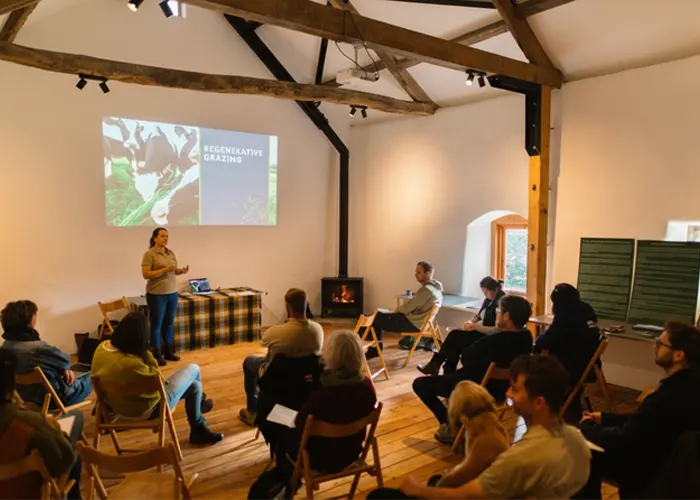
This is where we share what fifteen years of regenerative work in the uplands has taught us — how to read your soils and actually build them, how to graze for healthier stock and recovering ground, how to design a whole farm where the ecology and the economics work together, and how our WILD mapping turns your land’s potential into a plan.
Practical, evidence-based, and grounded in upland conditions rather than borrowed from somewhere flatter and drier.
You’ll get first word on training, farm visits and funding windows too — but mostly, you’ll learn.
What Distinguishes the Wilderculture Approach
The regenerative practices — holistic grazing, multispecies swards, integrated livestock systems — matter, and we use them throughout the work. But practices alone don’t transform a farm. A farmer who picks up the techniques without learning to read their own land as a living system ends up doing the right things in the wrong places, because they’re solving the wrong problem. So the ROOTED framework behind our work puts roughly half its weight on mindset, forty percent on systems design, and only ten percent on specific practices — because across hundreds of farms, the farmer who understands their land makes good decisions almost whatever practices they reach for, while the one who hasn’t will see even the right practices underperform.
What we teach is a reweaving, not an import. We take the best of the international regenerative movement — holistic management, agroecology, regenerative grazing, two decades of soil science — and bring it into honest relationship with what these landscapes already hold: surviving practice, place names, heritage breeds, the seasonal rhythms by which upland country has been worked for generations. It’s built on the science of how living systems actually work, and shaped by real upland conditions — thin soils, brittle hydrology, short seasons, hard weather, landscapes worked by human hands for six thousand years. The movement gives us the patterns; the uplands tell us how they have to be expressed here.
Wilderculture Integrated Landscape Design
We design every farm with a tool called WILD — Wilderculture Integrated Landscape Design. It divides any holding into three zones, each with a clear job: Protect and Restore (managed for the habitat, species or heritage it holds), Regenerate (productive land managed for living soil, diverse swards and real food), and Bioregionally Wilder (room for natural processes to lead). The discipline is naming the zone before arguing about the management. Most upland conflict — farming against rewilding, production against habitat — is really people answering different questions about the same ground. WILD separates the questions so each can be answered well. It’s also what lets neighbouring farms join up: design in the same language, and the conversation about wildlife corridors, water and connected habitat can actually happen.
What Farmers Gain

Environmental regeneration
Soil structure, water-holding capacity, and biodiversity all start to recover from the first season of regenerative management. Wildlife returns as habitat conditions improve. Carbon sequestration happens as a function of healthy soils, not as a separate target.

Economic viability
Inputs come down — feed, fertiliser, vet costs — as livestock health improves and natural productivity replaces bought-in resources. Premium markets for genuinely regenerative production are widening. The economics get more resilient because the system has more strands to it, not fewer.

Expert support
Fifteen years of practice. A live peer network of farmers in transition. Direct coaching from people who have done the work themselves. Ongoing support through the multi-year period that regenerative transition actually takes — not just a course and a goodbye.
Our Track Record
Regenerative practice across hundreds of thousands of acres of UK upland country. Farms and estates in transition. Measurable improvements in soil health, biodiversity, and farm economics. A network of farms now demonstrating in real conditions what regenerative upland management can do.
Who We Work With
Upland and hill farms running sheep and cattle on marginal land. Sporting estates managing large holdings where conservation, food production, and sustainable land management need to hold together. Conservation projects using livestock as ecological tools for habitat restoration or rewilding. Land consultants and advisors looking for robust methodology to deploy with their upland clients. Crofts and small-holdings in upland and island country. Whatever your scale, the question is whether you’re working with the conditions of your land or against them — and whether you want to do that with company, with a methodology behind you, and with peers in the same work.
Common Questions
Do I need to be organic?
No. We focus on building natural system function rather than certification standards.
What size farm?
Bioregional Networks are typically for holdings of 25 hectares or more, though we work with smaller crofts and holdings in network projects where the place and the practitioner are the right fit. Training events are open to any scale.
How long does transition take?
First-year improvements are real but soil biology and ecosystem complexity rebuild over five to fifteen years, depending on starting conditions and how degraded the land was when you began. Regenerative transition is multi-year work. The pace is set by the land, your budget and commitment not by us.
What does it cost?
Bioregional Farmer Networks are fully funded for participating farmers — costs are covered through the network funding partnerships we hold. Training events at Wilder Gowbarrow and across the regions carry fees that vary by course and length. Tailored consultancy through our partner Roots of Nature is priced by scope of work — best to be in conversation about what you’re looking for and we’ll talk through what’s appropriate.
What livestock systems?
Primarily sheep and cattle in upland and hill systems. The principles apply to any grazing operation — deer, goats, horses, mixed species, conservation grazing — and we work with all of these.
Can I visit a farm?
Yes. We run farm visits regularly across the regions and at Wilder Gowbarrow. Sign up for training and updates to hear about visits as they come up.
Ready to Begin?
Join a Bioregional Network
If you’re a Farmer/Estate owner/Crofter in one of our six regions and ready for intensive multi-year support.
Training and Updates
Receive alerts about training events, farm visits, conferences, and grant opportunities from Wilder Gowbarrow and across the regions.
Explore Our Approach
The Wilderculture Approach sets out the methodology behind our consultancy and training packages.